What Are the Top FFS Packaging Types for Buyers in 2026?
In 2026, buyers will judge FFS packaging by more than price and production speed. They will examine seal reliability, film efficiency, automation readiness, and end-of-life performance. The right format must protect the product while supporting faster, cleaner operations.
Packaging analyst David Luttenberger offers a practical principle: “The best package balances protection, efficiency, and the customer experience.” That balance explains why several FFS packaging types remain important. Pillow bags suit high-volume products and simple filling lines. Gusseted bags provide stronger shelf presence and increased capacity. Block-bottom bags offer stable stacking for retail and industrial applications. Mono-material PE or PP structures may attract buyers seeking simpler recycling pathways, although local systems still differ.
Real purchasing decisions require evidence. Buyers should compare leak rates, seal strength, line speed, changeover time, and material consumption. A package that looks sustainable may perform poorly under humidity, vibration, or rough transport. Small trials reveal more than attractive claims. Sometimes, the cheapest film creates higher waste.
There is no universal winner. Barrier needs, product density, equipment age, and regional recycling access change the answer. Some buyers may overvalue appearance. Others may underestimate operator training and maintenance. Strong suppliers will provide test data, transparent specifications, and realistic performance limits. The best 2026 choice will be the format that survives production, distribution, and customer handling without unnecessary material or avoidable compromise.
FFS Packaging Basics: VFFS and HFFS Across a $277.2B Flexible Market
What Are the Top FFS Packaging Types for Buyers in 2026?
Flexible packaging is moving toward faster, lighter, and more automated production. Grand View Research estimates the global flexible packaging market could reach about $277.2 billion in 2026. The figure varies by definition, especially when films, pouches, and converted materials are counted differently. That uncertainty matters.
VFFS remains practical for snacks, powders, grains, and frozen products. A vertical machine forms the film tube, fills it, and seals it in one continuous cycle. It uses compact floor space. It also supports high output with relatively simple changeovers. Buyers should inspect seal-jaw temperature control, film compatibility, and dosing accuracy. Small errors can create leaking bags.
HFFS suits flat products, bars, medical-free packaging, and shaped pouches. The film travels horizontally, giving operators better control over product placement and presentation. PMMI industry reports continue to identify automation, labor efficiency, and flexible format changes as major machinery priorities. Sustainability adds pressure, but recyclable structures may require narrower sealing windows. This is often overlooked. In real production, the cheapest machine can become expensive after repeated film trials, rejected packs, and slower cleaning. Smithers’ flexible packaging outlook also highlights material reduction and operational efficiency as continuing market drivers. Buyers should request documented line speeds, test results, and total ownership costs before choosing VFFS or HFFS.
HFFS for Retail Packs: Match Format Choice to Product and Shelf Life
HFFS packaging gives retail buyers several practical choices: pillow bags, gusseted bags, quad-seal packs, and small sachets. Each format changes product protection, filling speed, shelf presence, and material use. Smithers estimates the global flexible packaging market reached about $291 billion in 2023 and may exceed $339 billion by 2028. That growth reflects demand for convenient, lightweight retail formats.
Pillow bags suit snacks, powders, and products with moderate protection needs. Their simple seal structure can reduce material consumption and improve line speed. Gusseted bags offer more volume and stand better on shelves. They work well for pet food, grains, and larger dry products. Quad-seal packs create a stronger retail profile, but they may require more film and tighter machine control. The choice should follow the product, not only the shelf image.
Shelf life changes the decision. Oxygen-sensitive coffee, nuts, and powdered foods may need high-barrier laminates, nitrogen flushing, or stronger hermetic seals. Moisture-sensitive products need reliable seal integrity and controlled storage conditions. PMMI packaging research continues to identify convenience, product protection, and sustainability as major investment drivers. Still, a recyclable-looking pouch is not automatically a better pack. Its barrier performance, seal failure rate, and real recycling access deserve testing. Small details matter. A weak corner can waste the whole shipment.
Material Selection: Evaluate PE, PP, and Recyclable Films by APR Guidance
For buyers planning FFS packaging in 2026, material selection should begin with the product and the recycling pathway. Polyethylene, especially film-grade PE, remains practical for many pouches, liners, and bags. It offers reliable heat sealing and useful flexibility. However, a recyclable claim depends on local collection and sorting systems, not material choice alone.
APR guidance encourages designers to review the complete package. Check film structure, inks, adhesives, coatings, closures, and labels together. A PE package with incompatible layers may create problems during reprocessing. PP film can provide strong stiffness and heat resistance, which suits snack packs and applications needing sharper folds. Yet PP flexible-film recovery is still uneven across markets. Buyers should verify actual acceptance before approving large production volumes.
Test the package on a filling line. Watch seal strength, jaw temperature, puncture resistance, and product contamination. Small changes can affect performance. They can also affect recyclability. Clear or lightly printed films may support better sorting, while excessive coatings can complicate processing. Recyclable films deserve careful qualification, not optimistic wording. In practice, a package may pass a laboratory review but struggle in a local collection program. That gap deserves attention. Use APR design guidance as a technical reference, then confirm requirements with converters, recyclers, and regional recovery operators. The best choice is often the simplest structure that protects the product and fits a verified recycling route.
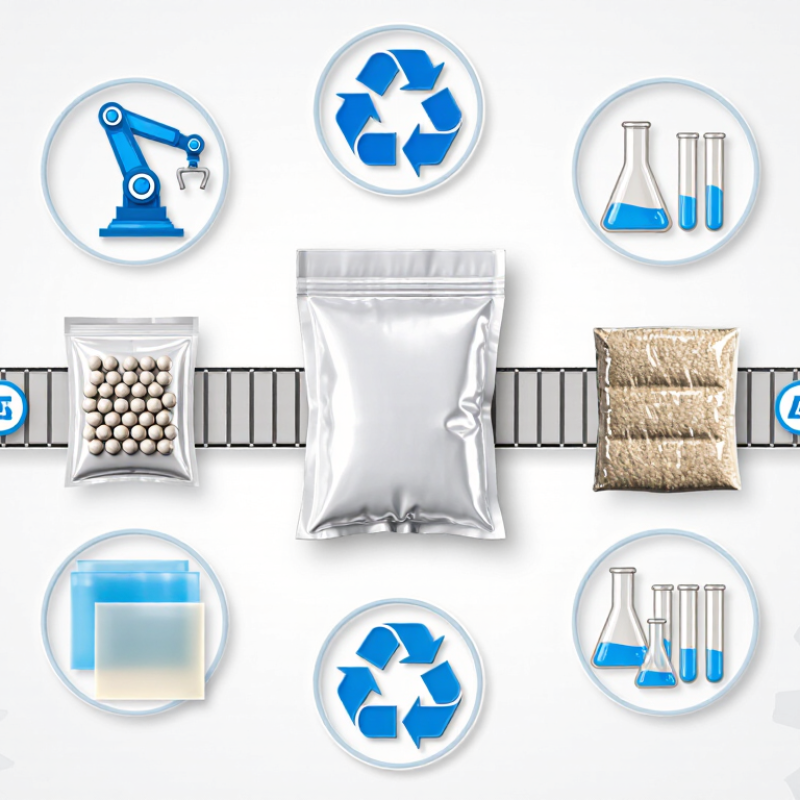
For FFS packaging buyers, mono-material PE and PP films generally offer simpler material identification than mixed PET/PE laminates. PE has the lowest typical melting range and is widely used for heat-sealable films, while PP provides higher heat resistance. APR recyclability depends on the complete package structure, additives, inks, closures, and the target recycling stream—not resin selection alone.
Buyer Scorecard: Balance Total Cost, Throughput, and 2026 Sustainability Targets
For 2026 buyers, the strongest FFS packaging choice depends on the product, speed target, and material strategy. Vertical form-fill-seal systems suit powders, granules, and many free-flowing products. Horizontal systems often handle bars, bakery items, and fragile solid goods more gently. Sachet and stick-pack formats can reduce material use, but their narrow seals demand careful film control.
A practical buyer scorecard should measure total cost, not only the machine price. Include film consumption, changeover time, cleaning labor, energy use, maintenance, and rejected packs. Throughput needs real production data. Ask for sustained output, not a short demonstration peak. Measure packs per minute during film changes, minor stops, and product variation. A fast machine can disappoint when operators spend hours correcting seal wrinkles.
Sustainability targets need measurable evidence. Compare recyclable mono-material options, downgauged films, recycled content, and scrap rates. Check whether the chosen structure protects shelf life. Less material is not better if damaged products increase waste. Request trial results using your actual product and proposed film. Start with reality. A spreadsheet can still mislead. Buyers should also examine training quality, spare-part access, and the supplier’s documented service response. One overlooked weakness may erase savings within a single production season.